#### Memory Models
* In SYCL the USM (unified shared memory) model can be used to manage data.
* Which model you choose can have an effect on how you enqueue kernel functions.
#### CPU and GPU Memory
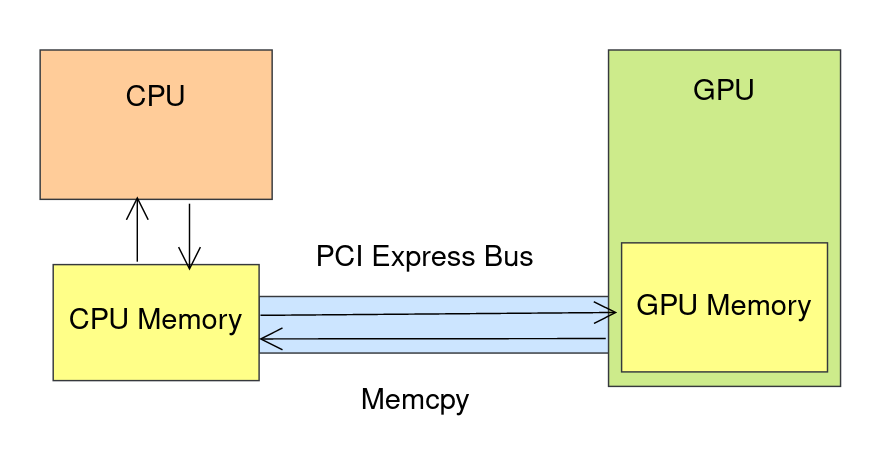
* A GPU has its own memory, separate to CPU memory.
* In order for the GPU to use memory from the CPU, the following actions must take place (either explicitly or implicitly):
* Memory allocation on the GPU.
* Data migration from the CPU to the allocation on the GPU.
* Some computation on the GPU.
* Migration of the result back to the CPU.
#### CPU and GPU Memory
* Memory transfers between CPU and GPU are a bottleneck.
* We want to minimize these transfers, when possible.
#### USM Allocation Types
* There are different ways USM memory can be allocated: host, device and shared.
| Type | Description | Access host | Access device | Nominal location |
|--------|---------------------------------|----------------|----------------|----------------------|
| device | device global allocations | ✗ | ✓ | device |
| host | host allocations | ✓ | ✓ | host |
| shared | Allocations shared between both | ✓ | ✓ | migrates as required |
#### Using USM - Malloc Device
// Allocate memory on device
T *device_ptr = sycl::malloc_device<T>(n, myQueue);

// Copy data to device
myQueue.memcpy(device_ptr, cpu_ptr, n * sizeof(T));

// ...
// Do some computation on device
// ...

// Copy data back to CPU
myQueue.memcpy(result_ptr, device_ptr, n * sizeof(T)).wait();

// Free allocated data
sycl::free(device_ptr, myQueue);
* It is important to free memory after it has been
used to avoid memory leaks.
#### Using USM - Malloc Shared
// Allocate shared memory
T *shared_ptr = sycl::malloc_shared<T>(n, myQueue);

// Shared memory can be accessed on host as well as device
for (auto i = 0; i < n; ++i)
  shared_ptr[i] = i;

// ...
// Do some computation on device
// ...

// Free allocated data
sycl::free(shared_ptr, myQueue);
* Shared memory is accessible on host and device.
* Performance of shared memory accesses may be poor depending on platform.
#### operator[]
gpuQueue.submit([&](handler &cgh){
  cgh.single_task<mykernel>([=]{
    out[0] = inA[0] + inB[0];
  });
});
* Data can be accessed from within a kernel function by
calling `operator[]`.
* `operator[]` for USM pointers must take a `size_t`.
## Questions
#### Exercise
Code_Exercises/Managing_Data/source
Implement a SYCL application that adds two variables
and returns the result using the USM memory model.